Contrast Agents & Labs
Contrast agents or contrast media, are used to improve CT and MRI images. Often, contrast materials allow the radiologist to distinguish normal from abnormal conditions.
- Our radiologists carefully evaluate each patient’s condition and medical history to determine the need for IV contrast media. Common exams that require contrast are CT and MRI scans.
- Contrast can be used to improve the clarity of CT and MRI images, but isn’t always necessary.
- Call our Radiologist Hotline at 919-788-7880 x 1 if you have questions about contrast.
CT Contrast & Creatinine Ordering Guidelines
- Contrast can be used to improve the clarity of CT images, but isn’t always necessary.
- Non-ionic, iodinated contrast is the medium used at WakeRad UNC REX.
- Add “contrast as medically indicated by the radiologist” on the imaging order to enable us to administer CT contrast when necessary.
- This ensures patients are exposed to the least amount of radiation possible.
- Contrast is typically used when imaging for cancer, cancer progression, inflammation, infection or abscess, lymphadenopathy or pulmonary embolism.
- Contrast is also administered when asked to surveil acute abdominal pain and review abdominal organs.
- Call our Body Imaging Physician Hotline at 919-788-7978 if you have questions about contrast.
Creatinine Labs
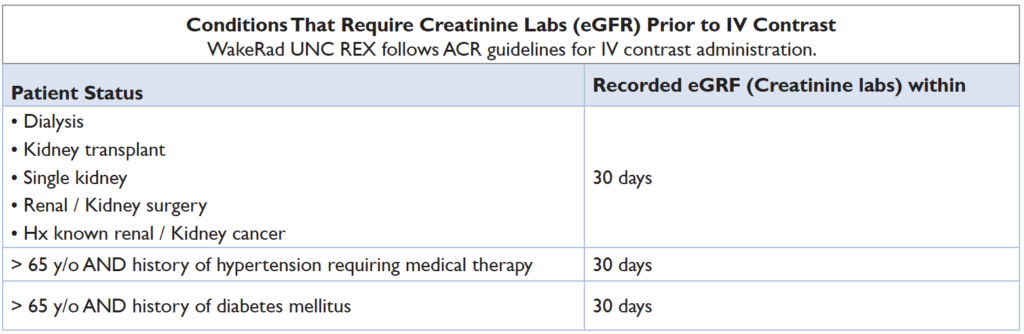
- A current creatinine level is required before a CT with contrast exam can be performed.
- WakeRad UNC REX can complete this lab work in our office on the same day of the patient’s exam. We use an iSTAT device to obtain a patient’s creatinine level. This ensures accurate lab levels and that the CT exam is performed safely and efficiently.
- Order “Draw for Creatinine levels if medically needed” when you order a CT exam for any patient that meets the criteria below.
MRI Contrast & Creatinine Ordering Guidelines
Unless recommended by a radiologist, MRI exams are performed either “without contrast” or “without and with contrast.”
Our radiologists use patient notes and medical history to determine the need for contrast.
Contrast can be used to enhance the clarity of images, but isn’t always necessary.
One exception: All MRI arthrograms should be ordered “with contrast.”
Call our MRI Physician Hotline at 919-788-7978 if you have questions about contrast.
With Contrasts
- An MRI with contrast provides detailed views of organs and their function, inflammation, tumors or blood flow and supply.
- Contrast can provide more details to help diagnose and stage diseases.
- During an MRI with contrast, the patient is injected with the contrast media which works with the MRI’s electromagnet to create a sharper image.
- MRE patients will receive both oral and intravenous contrast to enhance the images.
- MRI contrast media does not contain iodine and rarely causes allergic reactions.
- MRI arthrograms should always be ordered “with contrast.”
Without Contrasts
- Most MRI exams are performed without contrast.
- Non-contrast exams provide better images of blood vessel activity, aneurysms and blocked blood vessels.
- Most orthopedic and joint MRI exams do not need contrast.
- Sometimes when a “without contrast” study is being performed, our radiologists may determine – during the exam – that contrast would help produce clearer images. If this is the case, we will immediately contact the ordering provider for an updated order.
Creatinine Labs
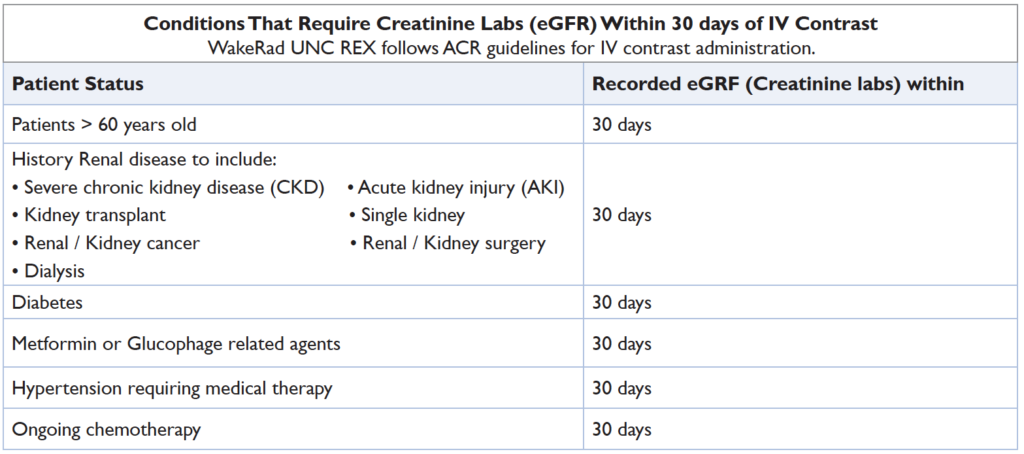
- A current creatinine level may be required before an MRI with contrast exam can be performed.
- WakeRad UNC REX can complete this lab work in our office on the same day of the patient’s exam. We use an iSTAT device to obtain a patient’s creatinine level. This ensures accurate lab levels and that the MRI exam is performed safely and efficiently.
- Order “Draw for Creatinine levels if medically needed” when you order an MRI exam for any patient who has any of the conditions listed below.